
MATERIALS EXPLAINED / GARAGE FLOOR COATINGS
Epoxy. Polyaspartic.
Polyurea.
Look beneath
the names.
A beautiful garage floor is a system of layers. Here’s what each material actually does, how flakes fit in, and why the usual “which is better?” comparison misses the point.
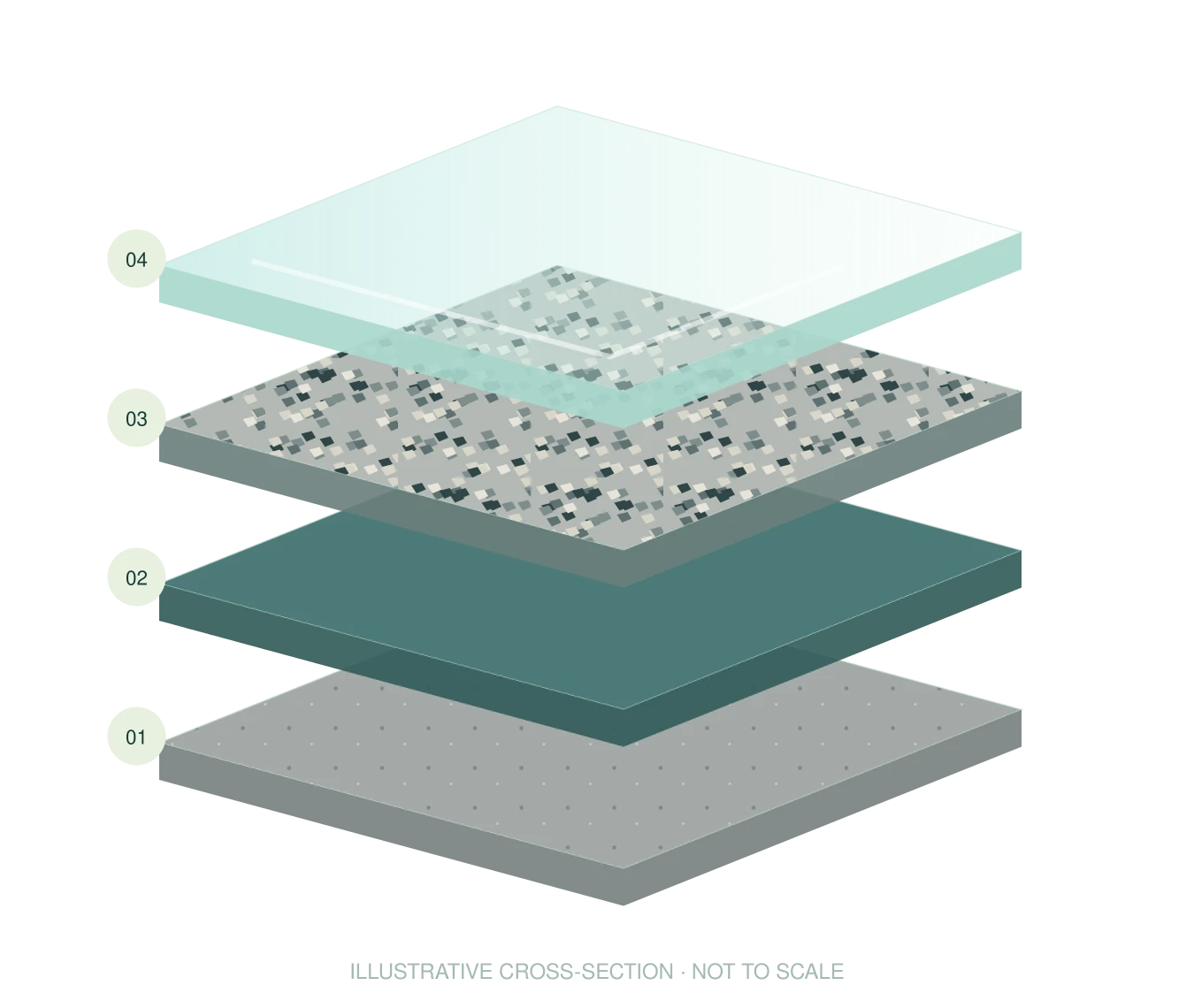
INSTALLATION ORDER · BOTTOM TO TOP
01 Concrete · 02 Epoxy · 03 Flakes · 04 Polyaspartic
01 Understand the chemistry
02 See the complete system
03 Ask better questions
THE USEFUL ANSWER
Epoxy can provide the base. Flakes provide the decorative broadcast. A compatible polyaspartic topcoat seals the surface. Polyaspartic is itself a type of polyurea—so these names do not describe three mutually exclusive floors.
IN THIS GUIDE
A better floor decision starts with a better specification.
01 / THE TERMINOLOGY
Are epoxy, polyurea and polyaspartic three different kinds of floors?
They describe coating chemistries. A finished floor can combine more than one.
“Epoxy floor” is often shorthand for a decorative resin-coated floor—even when its exposed surface is a different material. “Polyaspartic floor” may describe the finish coat, or a system that uses polyaspartic in several positions. Neither label tells you everything that is installed.
Epoxy is a resin-and-hardener coating chemistry. A suitable pigmented epoxy can bond to prepared concrete and receive a decorative flake broadcast. Polyurea is a broader chemistry family with different formulations and uses. Polyaspartic coatings commonly used for these floors are aliphatic polyureas made with polyaspartic chemistry.
POLYUREA FAMILY
Different formulations. Different application methods and performance.
Polyaspartic
A type of polyurea used in many decorative flooring systems.
Conceptual chemistry relationship. Epoxy is a separate chemistry and can work alongside these materials in one compatible system.
That is why “polyaspartic versus polyurea” needs context. Installers may use “polyurea” to mean a non-polyaspartic base coat and “polyaspartic” to mean the clear finish. That is useful trade shorthand, but it does not make the chemistry families unrelated.
The question that cuts through the label
“Which exact product touches my concrete, which product receives the flakes, and which product will my tires and shoes touch?”
02 / ANATOMY OF A FLAKE FLOOR
What actually goes down, and in what order?
The CR Painting system described here uses 4195 epoxy → decorative flakes → a compatible polyaspartic topcoat over prepared concrete. Follow the numbers from the bottom up: 1 is the prepared concrete substrate, 2 is the epoxy base, 3 is the flake broadcast, and 4 is the polyaspartic topcoat. The substrate is not an applied coating. The diagram separates these components so you can see their roles; it is not a thickness specification.
INSTALLATION ORDER · BOTTOM TO TOP
01 Concrete · 02 Epoxy · 03 Flakes · 04 Polyaspartic
Explore the system · 01 → 04
01 · Prepared concrete
The substrate supporting everything above it. Surface preparation, repairs and moisture evaluation come before decorative coating work.
A premium topcoat cannot repair a poor concrete interface.
02 · 4195 epoxy base
The pigmented receiving coat in this CR Painting configuration. It is applied to suitably prepared concrete and receives the decorative flakes.
A product-specific role, not a rule for every floor system.
03 · Decorative flakes
Broadcast media embedded in the receiving coat. Blend, size and coverage shape the appearance before the system is sealed.
Flakes are not a resin and do not replace the clear finish.
04 · Polyaspartic topcoat
The exposed wear surface. It seals the flake broadcast and provides the specified finish, cleanability and resistance to everyday exposure.
Clear does not mean invisible work: this is the surface you use.
01
Start with the slab—not the bucket.
Existing coatings, contaminants, surface condition, cracks and moisture must be evaluated. Mechanical preparation creates the profile required by the selected coating. Repairs and moisture treatment, where needed, belong in the plan before the decorative work begins. A high-performance finish cannot compensate for an unsuitable substrate.
02
The epoxy base: adhesion and a home for the flakes.
4195 is a direct-to-concrete, pigmented epoxy formulated to receive acrylic flakes. Its product description identifies it as a 95% solids primer that can receive the broadcast without a separate primer in its specified application. That is a product-specific feature—not permission to omit a primer or moisture evaluation from every epoxy system.
03
The flakes: decorative material, not another resin.
Flakes are broadcast into the receiving coat while it can accept them. Their blend, size and coverage create the visual pattern. A full broadcast and a sparse decorative scatter are different specifications. After curing, loose material is removed and the broadcast is prepared for the next compatible coat. Flakes influence appearance and texture; they are not a substitute for a protective topcoat.
04
The polyaspartic topcoat: the surface that faces daily use.
The clear finish seals the broadcast and becomes the exposed surface. Suitable aliphatic products offer color stability and documented wear resistance. Application thickness, coverage and any additional seal coats follow the selected system’s instructions. More liquid or more coats are not automatically better if they exceed the product specification.
Three visible components do not always mean three rolled coats. Flakes are broadcast media. A project may also need a separate primer, moisture-control layer or additional seal coat. Ask for the actual build-up in writing.
03 / THE EXPOSED SURFACE
Why use polyaspartic as the topcoat over epoxy and flakes?
Because the concrete interface and the exposed finish have different jobs. In this configuration, the epoxy is selected for its role beneath the broadcast. The compatible polyaspartic is selected for the surface above it.
A suitable clear polyaspartic can combine an attractive finish with abrasion resistance, chemical resistance and rapid curing. Aliphatic, color-stable formulations are particularly relevant at a garage entrance where sunlight reaches the surface. Those benefits depend on the exact product and its application—not just the word on the estimate.
Does the clear coat make every layer UV-proof?
No. A color-stable topcoat resists discoloration of that coating. It does not automatically act as a complete UV-blocking shield for all materials below. Exposed epoxy edges, the flake blend and the whole system’s suitability still matter. Ask what the manufacturer approves for the intended exposure.
Can polyaspartic ever go directly on concrete?
Yes, in systems and products approved for that use. Polyaspartic is the topcoat in the CR Painting configuration described here; “polyaspartic must never touch concrete” is not a universal technical rule. A manufacturer-approved polyaspartic base system should be assessed on its own specification.
04 / A FAIR COMPARISON
Compare the system—not one material against an entire floor.
Comparing an untopcoated epoxy kit with a professionally prepared, full-flake floor and a premium clear finish does not isolate the effect of the resin chemistry. Preparation, broadcast coverage, film build and the exposed coating all changed.
CONFIGURATION A
Epoxy base + polyaspartic finish
Compatible epoxy receiving coat
Decorative flake broadcast
Compatible polyaspartic topcoat
The configuration discussed for CR Painting.
CONFIGURATION B
Polyurea base + polyaspartic finish
Specified polyurea receiving coat
Decorative flake broadcast
Compatible polyaspartic topcoat
A different base chemistry; ask for the actual products.
CONFIGURATION C
Polyaspartic-based system
Approved polyaspartic base
Decorative flake broadcast
Approved polyaspartic finish
Valid where the manufacturer specifies this assembly.
Illustrative configurations, not installation recipes. Approval and compatibility must be established for the actual products.
| Compare this | A useful specification | An incomplete claim |
|---|---|---|
| Concrete interface | Named base/primer and required surface preparation | “Premium floor coating” |
| Decorative coverage | Flake blend, size and broadcast coverage | “Flakes included” |
| Exposed surface | Named topcoat and intended exposure | “It’s polyurea” |
| Film build | Product-specific coverage and dry film thickness | “Thicker is always better” |
| Schedule | Recoat, foot-traffic and vehicle-return conditions | “Done in one day” |
| Project scope | Repairs, moisture provisions, edges and exclusions | One price without a written assembly |
There is no universal winner based on the chemistry name alone. Ask which assembly is appropriate for your slab and how the installer will deliver the specified system.
05 / WHERE THE CONFUSION STARTS
Six coating claims that deserve a second question.
“Polyurea always turns yellow.”
Which polyurea formulation?
Aromatic and aliphatic products should not be treated as interchangeable. Color-stable aliphatic polyurea coatings exist, including polyaspartic products. “Polyurea” by itself does not establish UV performance. Ask for the exact product and its intended exposure.
“An epoxy base means you bought an inferior floor.”
What is the epoxy doing in that assembly?
A suitable epoxy receiving coat and a compatible polyaspartic finish can serve different functions in one system. Judge the documented assembly and installation scope. A bucket category is not a complete performance assessment.
“It’s 100% solids, so it must be the strongest.”
Solids content is not a durability score.
Solids content helps describe the material remaining as the film forms. It does not replace adhesion, abrasion or chemical-resistance data. It also does not tell you whether the floor was prepared correctly. 4195, for example, is described by its manufacturer as 95% solids; that percentage alone is not a reason to accept or reject a system.
“One-day installation means you can park tonight.”
Installation time and return-to-service time are separate.
Finishing the application is not the same as reaching the specified cure for vehicle traffic. Foot traffic, moving belongings and parking may have different release times. Obtain instructions for the actual product, slab temperature and site conditions.
“Flakes make it non-slip.”
Appearance is not a slip-resistance specification.
The final texture depends on the broadcast, how it is prepared, the finish coat and any specified traction aggregate. A glossy floor can still be slippery when wet or contaminated. Discuss the intended texture and wet-use conditions rather than accepting an absolute “non-slip” promise.
“The clear topcoat fixes anything underneath.”
Every interface still has to work.
Sealing over contamination, loose flakes or a poorly bonded base does not correct the underlying issue. Recoat windows and surface preparation matter between coats as well as at the concrete. A strong surface is only one part of a sound assembly.
06 / THE LOCAL CONTEXT
What should homeowners in Tracy, the Central Valley and East Bay consider?
Whether your garage is in Tracy or another Central Valley community such as Manteca, Lathrop or Modesto—or in East Bay cities such as Brentwood or Livermore—start with how the space is actually used. Mountain House homeowners can use the same questions to evaluate their coating options. Does afternoon sun reach the garage threshold? Do you rinse the floor? Is the slab already painted? Will you store tools, park daily or use the space as a workshop?
The open-door edge is a different exposure zone.
Mark where the coating will stop and where direct sun reaches it. The exterior apron, driveway and garage interior should not automatically receive the same specification. An outdoor-rated topcoat alone does not establish that the whole assembly is suitable for exterior service.
The slab can be different from the weather forecast.
Application decisions should consider the concrete’s condition and temperature, moisture, ambient conditions and the product’s limits. An installation calendar should leave room for preparation and the required cure—not force every slab into the same timetable.
Your chosen finish should fit your routine.
Discuss flake color and size together with cleanability and traction. Request a physical sample when available: a screen shows a color impression, but cannot tell you how the finished texture feels underfoot.
For garage floor projects in Tracy, Manteca, Lathrop, Modesto, Mountain House, Brentwood or Livermore, contact CR Painting to discuss your location and schedule a free on-site estimate. The visit provides an opportunity to inspect the slab, listen to your goals and discuss the coating plan in person. For service details, visit CR Painting’s epoxy and polyaspartic garage floor coating service. This guide explains the materials; the project estimate should define what your own slab needs.
07 / TAKE THIS TO YOUR ESTIMATE
Seven questions to ask before choosing a coating contractor.
- What are the exact products in each layer?Request manufacturer and product names for the primer/base, receiving coat and topcoat.
- How will you evaluate and prepare this slab?Ask about existing coatings, contamination, mechanical preparation, repairs and moisture.
- Is this a partial or full flake broadcast?Confirm the blend, size, coverage and how the broadcast will be sealed.
- What film build will be installed?Ask for the specified coverage and dry film thickness, not just a coat count.
- How will you handle sunlight and wet conditions?Discuss the garage threshold, exterior boundaries and final surface texture.
- When can I walk on it, move items back and park?Get separate written instructions for each activity.
- What does the written warranty actually cover?Read the terms for adhesion, discoloration, moisture, substrate movement and maintenance.
08 / QUICK ANSWERS
The questions behind the search.
Can a floor be both epoxy and polyaspartic?
Yes. One compatible assembly can use an epoxy base, decorative flakes and a polyaspartic topcoat. The names can describe different layers of the same floor.
Is polyaspartic the same as polyurea?
Polyaspartic coatings used in these systems are a type of polyurea. Not every polyurea is polyaspartic, and different formulations can have different application and performance characteristics.
Do flakes go above or below the clear coat?
In the illustrated system, flakes are broadcast into the receiving base coat and then sealed beneath the compatible clear polyaspartic finish. They are decorative media rather than a separate liquid coating.
Why does CR Painting use polyaspartic on top?
In the system described here, 4195 epoxy receives the flakes and a compatible polyaspartic provides the exposed finish. This assigns the base and the wear surface different roles within the complete assembly.
Will a topcoat stop a concrete crack from coming back?
Do not assume that it will. Coatings are not structural concrete repairs. Existing cracks, moving joints and slab movement need appropriate evaluation and treatment; movement can remain visible or affect the coating.
Can an old epoxy floor simply receive polyaspartic?
Sometimes, but only after checking the existing coating’s adhesion, condition and compatibility. Cleaning, profiling or removal may be necessary. A clear finish should not be used to bury a failing coating.
Is a polyaspartic finish scratch-proof or stain-proof?
No coating should be assumed immune to damage. Choose documented resistance appropriate to the use, clean spills promptly and follow the manufacturer’s care instructions.
A CLEAR SYSTEM. A BETTER CONVERSATION.
Let’s look at your garage.
Planning a garage floor project in Tracy, Manteca, Lathrop, Modesto or Mountain House—or in Brentwood or Livermore in the East Bay? Contact CR Painting to coordinate a free on-site estimate. We’ll look at your slab, listen to your ideas and discuss an appropriate coating plan in person.
Diagrams are explanatory illustrations, not project photos or scale drawings. Product instructions and the written project specification govern the installation.
Related reading: Garage floor coating services · The complete guide to garage floor coating in California
